Real estate and lending data from HousingWire, Redfin, FICO, and NAR shows that while 43% of sellers are cutting listing prices, offering a seller-paid mortgage rate buydown often delivers superior value for both parties. With 63% more sellers than buyers in the market, redirecting a $10,000 concession into a temporary 2-1 rate buydown can reduce a buyer's initial monthly payment roughly eight times more than an equivalent $10,000 price reduction, helping sellers preserve their sale price while addressing buyer affordability.
In today’s market, a growing number of sellers are opting to do something called a price cut – especially when their house has been on the market for a while without any bites.
According to HousingWire Data as many as 4 in 10 (43%) sellers are going this route – that’s the highest it’s been in 4 years. But what if there’s another (potentially better option) for your bottom line? And it’s just as appealing, if not more so, to today’s buyers?
Enter the rate buydown.
Why Buyers Expect a Deal
First, let’s set the stage on why some compromise may be necessary in today’s market.
In September, Redfin says there were 63% more sellers than buyers in the market. And with so many sellers active and relatively few buyers by comparison, those purchasers are realizing they have more power. And as mortgage rates continue to put a squeeze on their budgets, they’re leaning in and using it.
One of the most common negotiation points? The price.
That’s because they want to feel like they’re getting a deal and they want to see their monthly payment drop. And since buyers can’t control rates, the price feels like the most obvious lever to pull.
But the savviest sellers realize being flexible doesn’t always mean a lower price, paying for a buyer’s rate buydown might work better.
What Is a Rate Buydown?
A buydown is money paid at closing to lower the buyer’s mortgage rate. When you pay it as the seller, you are paying some of the buyer’s interest ahead of time, so the buyer gets a lower rate and monthly payment. And that’s especially appealing to today’s buyers.
Temporary buydowns lower the rate for the first few years, then it goes back to the full rate. The more years a buydown covers, the more it costs. These work well for buyers who expect to refinance within a certain amount of time.
A permanent buydown lowers the rate for the whole loan. These are paid for with “discount points.” One point costs 1% of the loan. According to FICO, each point generally lowers the rate by about a quarter of a percent. This type of buydown works well for buyers who plan to stay in the home for a long time.
Same Money, Different Results
And here’s why these can be a win-win for both buyers and sellers. Rate buydowns help sellers stand out in a crowded market and they can have a bigger impact on your buyer than a price cut would.
Here’s an example to show you what that could look like.
Let’s say you’re willing to make a $10,000 concession to help get the deal done. Take a look at these three ways to spend that money and the impact they could have on a buyer’s $420,000, 30-year fixed loan at 7%:
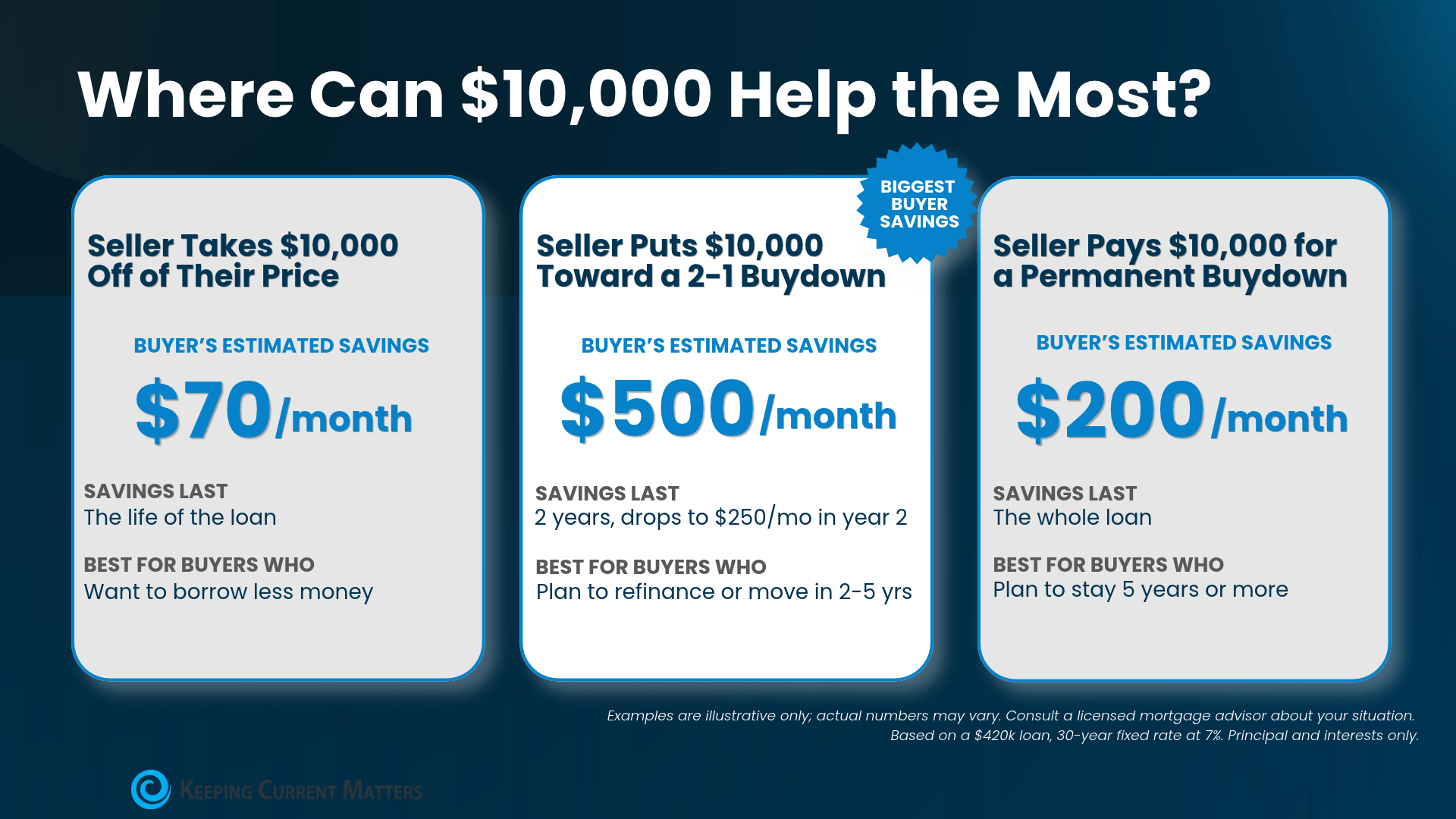
It’s the same $10,000 from the seller. But a 2-1 buydown saves the buyer about eight times more each month in the first year.
And since most buyers shop by monthly payment, that’s what grabs their attention.
That’s what makes a rate buydown worth considering. Instead of reducing your asking price, you may be able to use that same money to have a bigger impact on your buyer’s monthly payments. And depending on what matters most to that buyer, the immediate savings could be more appealing than a price reduction.
The key is working with your agent and the buyer’s lender to compare the options and see which one makes the most sense.
Things To Know
Loan programs cap how much a seller can pay toward a buyer’s costs.
Money toward buydowns doesn’t limit what else a buyer may ask a seller to pay for. Buyers may still ask for repairs or other concessions.
Putting the buydown offer in your listing lets agents and buyers know it’s an option.
Your agent can run scenarios on buydowns and other costs of selling in advance so you’re prepared when an offer comes in.
As Lawrence Yun, Chief Economist at the National Association of Realtors (NAR), says:
“Home sellers need to be realistic about local market conditions, which could require price discounts and other incentives to attract buyers.”
And sellers who offer solutions like buydowns can make meaningful impact where home buyers need it most: in their wallets.
Frequently Asked Questions
Q: How does a seller-paid rate buydown compare to a price reduction?
A: While both options reduce the seller's net proceeds by the same dollar amount, a rate buydown directly lowers the buyer's mortgage interest rate, creating a much larger drop in their monthly payment. For example, a $10,000 concession applied toward a 2-1 buydown on a $420,000 loan can save a buyer roughly eight times more per month in the first year than a $10,000 price reduction.
Q: What is the difference between a temporary buydown and a permanent buydown?
A: A temporary buydown (such as a 2-1 or 3-2-1 buydown) lowers the buyer's interest rate for the first one to three years before returning to the original fixed rate, making it ideal for buyers who plan to refinance later. A permanent buydown uses discount points (where 1 point equals 1% of the loan amount and typically lowers the rate by ~0.25%) to reduce the interest rate for the entire life of the loan.
Q: Are there limits on how much a seller can contribute toward a rate buydown?
A: Yes. Mortgage loan programs (Conventional, FHA, VA, and USDA) place maximum caps on total seller concessions based on loan type and down payment percentage. Sellers should also remember that funds dedicated to a rate buydown count toward total concession limits alongside closing cost credits or repair allowances.
Bottom Line
When you're looking for ways to make your house more appealing to buyers, a price reduction isn't your only option. A mortgage rate buydown could help a buyer save more each month, especially in the early years of their loan.
Talk to your agent or a trusted lender which incentives could make the biggest difference for buyers in our market, while still protecting your bottom line.